

Language & Location
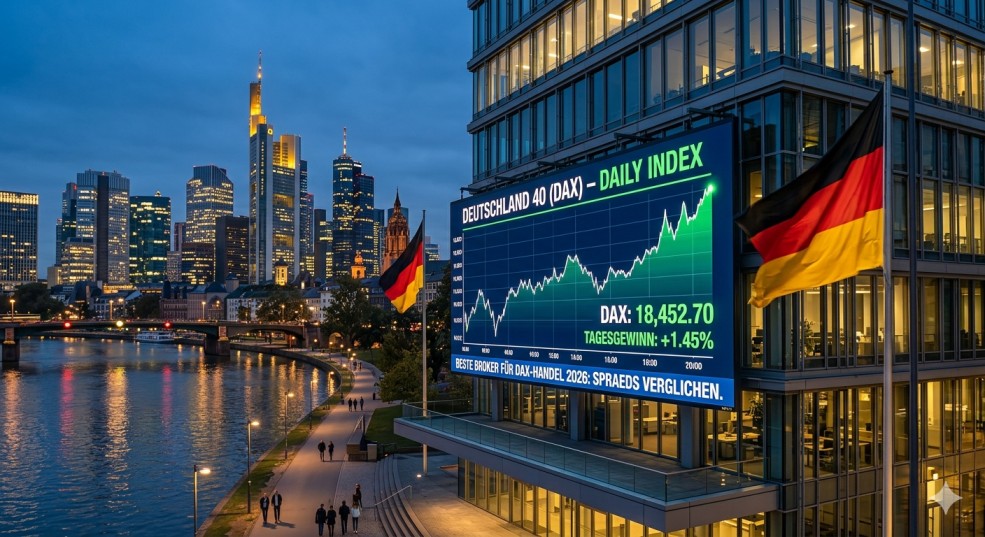
If you are a trader based in Germany, the DAX is almost certainly on your radar. It is Germany's flagship stock index—40 of the country's largest and most influential companies, from Volkswagen and BMW to SAP and Deutsche Bank—and it is by far the most actively traded index among German retail CFD traders. When German markets move, the DAX moves with them.
But here is the thing that separates profitable DAX traders from those who consistently underperform: the broker. Specifically, the spread your broker charges every time you open and close a position. On a fast-moving index like the DAX, a wide spread eats directly into your results on every single trade. Over dozens of trades a week, the difference between a tight spread and a wide one is not marginal—it is significant.
At TraderGuide, we track real spreads across 50+ regulated brokers during live market conditions. Not advertised minimums. Not best-case numbers from a quiet Friday afternoon. The widest spread observed during normal EU and US trading sessions—which is the realistic worst case you should plan around. On most trading days, you will likely see tighter spreads than the figures shown here.
This article compares the four cheapest brokers for DAX trading available to German traders in 2026, based on TraderGuide's live spread data.
The DAX 40—officially the Deutscher Aktienindex—is Germany's benchmark stock market index. It tracks the 40 largest companies listed on the Frankfurt Stock Exchange, weighted by market capitalisation, and is one of the most closely watched indices in the world.
For German traders, the DAX is more than just a number. It is a direct reflection of the German economy—and in 2026, that economy is navigating a complex set of pressures: energy market disruption stemming from the Middle East conflict, ongoing uncertainty around European interest rates, and significant shifts in the global automotive sector affecting some of the index's largest constituents.
All of this creates meaningful daily price movement in the DAX. And meaningful price movement creates trading opportunities—but only if your broker is not taking an outsized share of every trade through an unnecessarily wide spread.
Trading the DAX as a German retail client is straightforward, but the regulatory framework that applies to you depends on which broker entity you open your account with — and this varies across the four brokers in this comparison.
FP Markets and Tickmill both hold CySEC licences and serve German clients through their EU-regulated entities. This means full MiFID II protections apply: negative balance protection, segregated client funds, and clear risk disclosures. The ESMA leverage cap of 20:1 on major indices including the DAX applies to both. EU clients of CySEC-regulated brokers are also covered by the Investor Compensation Fund (ICF) up to €20,000 in the event of broker insolvency.
Trade Nation and Global Prime do not hold EU or CySEC licences. German clients opening accounts with either broker are onboarded through non-EU entities—Trade Nation through its SCB (Bahamas) entity, and Global Prime through its ASIC (Australia) or VFSC (Vanuatu) entity. MiFID II protections do not apply to these accounts. ESMA leverage limits also do not apply, meaning higher leverage than 20:1 on the DAX may technically be available—but with it comes a reduced level of regulatory protection compared to a CySEC-regulated account.
This does not make Trade Nation or Global Prime unsafe—both are well-established, reputable brokers with strong track records. But it is an important distinction for German traders to understand before opening an account. Always verify which entity you are being onboarded to and what protections apply in your specific situation.
Spreads shown are the widest observed during normal EU and US trading sessions. This is a realistic worst case for an ordinary trading day. On many days, actual spreads will be tighter than what is shown here. Spreads can widen further during major news events or periods of very low liquidity.
| Broker | DAX Spread | TraderGuide Ranking | Spread Type | Platforms | Regulation |
|---|---|---|---|---|---|
| FP Markets | 0.50 | #14 | Variable | MT4, MT5, cTrader, TradingView | ASIC, CySEC, FSCA, FSA, CMA |
| Tickmill | 0.50 | #15 | Variable | MT4, MT5 | FCA, CySEC, FSA, DFSA, FSCA |
| Trade Nation | 0.80 | #1 | Fixed | TN Platform, MT4 | FCA, ASIC, FSCA, SCB |
| Global Prime | 0.80 | #5 | Variable | MT4, TraderEvolution, TradingView | ASIC, VFSC, FSA |
Spreads tracked by TraderGuide during the EU and US trading sessions under normal market conditions. On most trading days, spreads will be tighter than the figures shown. Spreads can widen further during extraordinary market events or very low liquidity periods.
Let us put these numbers into real terms, because the difference between 0.50 and a wider spread adds up far faster than most traders realise.
The DAX is priced in points. If you trade €5 per point on the DAX with a broker charging a 0.50 spread, your entry cost per round trip is €2.50. With a broker charging 2.00 points, the same trade costs €10.00—four times as much.
| Trading activity | Cost at 0.50 spread (€5/pt) | Cost at 2.00 spread (€5/pt) | Annual difference |
|---|---|---|---|
| 5 trades per week | €325 per year | €1,300 per year | €975 per year |
| 10 trades per week | €650 per year | €2,600 per year | €1,950 per year |
| 20 trades per week | €1,300 per year | €5,200 per year | €3,900 per year |
For illustration only. Based on €5 per point per trade, 52 weeks.
These numbers make the broker choice very concrete. Use our Spread Calculator to run the numbers based on your own stake size and trading frequency.
Best for tightest DAX spread: FP Markets or Tickmill Both come in at 0.50 points on the DAX—the tightest figures in TraderGuide's live data for German-accessible brokers. FP Markets, regulated by ASIC and CySEC, offers an outstanding platform range: MT4, MT5, cTrader, and TradingView, giving traders maximum flexibility in how they analyse and execute on the DAX. Tickmill, regulated by FCA and CySEC among others, is a lean, efficient broker built around fast execution with no dealing desk intervention—well suited to active DAX traders and scalpers. Both are variable spread brokers, meaning the 0.50 figure represents the realistic worst case under normal conditions; spreads will often be tighter.
Best for cost certainty: Trade Nation Trade Nation is ranked #1 overall on TraderGuide—and its defining feature is its fixed spread model. A fixed spread of 0.80 on the DAX means the cost never changes, regardless of what the market is doing. For context: a variable spread broker showing 0.50 under normal conditions can widen to 3.00, 4.00 or beyond during fast market moves or major news releases. Trade Nation's 0.80 stays at 0.80, always. For German traders who want to know their exact entry cost before they place any trade—especially those active around German economic data releases, ECB announcements, or earnings from major DAX constituents—this predictability is a genuine advantage. Trade Nation is regulated by FCA, ASIC, and FSCA.
Best for ECN pricing and transparency: Global Prime Global Prime is ranked #5 overall on TraderGuide and has built its reputation around transparency. It is a genuine ECN broker with direct access to 26+ tier-1 liquidity providers, and its unique trade receipt system lets clients see exactly where and how their orders were filled—a level of openness rare in retail trading. The DAX spread of 0.80 is highly competitive, and execution is consistently smooth. Global Prime also supports TradingView alongside MT4 and TraderEvolution, giving DAX traders strong charting options. Regulated by ASIC, with a VFSC entity for international clients.
1. That the broker accepts German clients Not every broker on TraderGuide accepts clients from Germany. All four brokers in this comparison do—but always verify directly with the broker which entity and regulatory framework applies to your account before depositing.
2. The leverage available Under ESMA rules, the maximum leverage for German retail traders on major indices including the DAX is 20:1. This means a €1,000 margin deposit gives you a €20,000 position in the DAX. All four brokers in this comparison apply this limit for their EU retail client accounts.
3. Fixed vs variable spread Variable spreads can be very tight under normal conditions and widen significantly during volatility. If you trade around news events—German inflation data, ECB rate decisions, or major DAX earnings—a fixed spread broker like Trade Nation removes that uncertainty entirely.
4. Platform compatibility All four brokers support MT4, which remains the most widely used platform for index CFD trading. FP Markets adds MT5, cTrader and TradingView; Global Prime adds TradingView and TraderEvolution; Trade Nation offers its own clean proprietary platform alongside MT4.
5. The spread TraderGuide actually observed—not the advertised minimum Some brokers advertise DAX spreads of "from 0.0" but the real observed spread during live trading tells a different story. TraderGuide's data reflects what traders actually encounter, not what is printed in the marketing materials. This is the only number worth comparing.
What is the DAX and how is it calculated? The DAX 40 (Deutscher Aktienindex) is Germany's primary benchmark stock index, tracking the 40 largest companies listed on the Frankfurt Stock Exchange by market capitalisation. It is a performance index, meaning dividends are reinvested—unlike many other global indices which are price indices only. This makes it behave slightly differently to indices like the FTSE 100 or S&P 500, and is worth understanding if you are trading it for the first time.
What are the trading hours for the DAX? The DAX cash index trades during Frankfurt Stock Exchange hours: 09:00–17:30 CET. However, DAX CFDs are typically available to trade almost 24 hours a day through most brokers, with a short daily closing period. Spreads are generally tightest during the main Frankfurt session and widen outside of these hours.
What leverage is available on the DAX for German retail traders? It depends on which broker entity you open your account with. For German clients trading through a CySEC-regulated entity—such as FP Markets or Tickmill—ESMA regulations cap leverage at 20:1 on major indices including the DAX. For German clients using a non-EU entity such as Trade Nation's SCB (Bahamas) entity or Global Prime's ASIC/VFSC entity, ESMA limits do not apply and higher leverage may be available. Higher leverage increases both potential gains and potential losses, and comes with reduced regulatory protections. Always confirm which entity governs your account before opening it.
Which broker has the tightest DAX spread for German traders? Based on TraderGuide's live spread tracking data for 2026, FP Markets and Tickmill share the tightest observed DAX spread at 0.50 points among brokers available to German clients. Full rankings are available at traderguide.com.
Is DAX CFD trading taxable in Germany? Yes. Unlike spread betting in the UK, CFD trading profits are subject to capital gains tax (Abgeltungsteuer) in Germany at a flat rate of 25% plus solidarity surcharge, applied to net trading gains above the annual exempt amount (Sparerpauschbetrag). CFD losses can be offset against other capital gains. You should consult a German tax adviser (Steuerberater) for guidance specific to your situation.
What moves the DAX? The DAX is driven by a combination of German and European economic data, ECB monetary policy decisions, global risk sentiment, and the individual performance of its major constituents. Key sectors represented in the index include automotive (Volkswagen, BMW, Mercedes-Benz), chemicals (BASF), technology (SAP, Infineon), and financial services (Deutsche Bank, Allianz). In 2026, energy prices—heavily influenced by the ongoing Middle East situation—have added an additional layer of volatility to DAX movements.
The DAX is Germany's home market, and for active German traders it offers some of the most familiar and frequently watched price action in the world. But familiarity with the market does not offset the cost of an expensive broker. At 0.50 points, FP Markets and Tickmill offer the tightest observed DAX spreads among the brokers available to German traders in TraderGuide's live data. Trade Nation offers the unique security of a fixed spread at 0.80, and Global Prime combines competitive ECN pricing with a level of transparency that sets it apart.
Use our Match Me tool to find the broker that suits exactly what you trade—it takes 30 seconds and is completely free.
Disclaimer
Trading and investing in financial instruments, including forex, CFDs, and other assets, involve a high level of risk. It is possible to lose all your invested capital. These activities may not be suitable for all individuals, and you should only engage in them if you fully understand the risks involved and have the financial capacity to bear any potential losses.
TraderGuide does not provide financial, investment, or legal advice. The information provided on this website is for informational purposes only and should not be considered as a recommendation or endorsement of any specific trading platform or strategy. For more details, please review our Terms and Conditions.
© 2026 TraderGuide. All rights reserved.
